Karmic tail “Warrior” (12/19/7)
You notice unfairness quickly, protect the people you care about, and prefer movement to waiting. Those qualities can be a real source of support. Yet a pause may feel like losing, disagreement like a challenge, and a conversation with someone close like a contest. The Warrior image helps separate courage from the habit of living on alert.
- Section
- Karmic Tails
- Reading
- 9 min read
- Author
- ArcFlow
- Updated
- Audio
The core: strength does not need a war
In the Matrix of Destiny tradition, the 12-19-7 combination is called the Warrior. It is not a biography of a past life, a personality diagnosis, or a prediction of events. It can be used as a mirror for a familiar way of handling pressure. When someone fears losing influence, being overlooked, or becoming powerless again, they gather themselves, speed up, and move toward confrontation. Sometimes that response is necessary. Sometimes the fight begins before it is clear that there is a real threat.
The Warrior carries valuable resources: decisiveness, willingness to take responsibility, and the ability to stay present in a difficult moment. In a team, this person may notice risk first; at home, they can organize themselves in a crisis; in their own work, they do not wait for perfect conditions. The difficulty is not strength itself but having only one setting. When recognition arrives only after victory, rest feels weak, and asking for help feels like debt, energy easily turns into irritation and isolation.
A useful question is not “Why am I so conflict-prone?” A more precise one is: “What am I protecting right now, and at what cost?” Perhaps a clear refusal, a conversation with a manager, or a safety decision is needed. Or perhaps you are facing a person with another pace, a mistake, or a different view. These are different situations. Seeing the difference lets you keep your character without wounding the people you wanted to protect in the first place.
How the Warrior can appear in everyday life
At work, this pattern can look impressive. You take on the difficult task, spot the weak point in a plan, offer a solution, and are ready to own the result. Trouble starts when colleagues stop bringing ideas because every discussion becomes an argument about speed and certainty. You may interrupt someone, finish their work at night, then resent the fact that everything rests on you. From outside, it resembles high standards; inside, there may be fear that without constant pressure you will no longer matter.
In relationships, a warrior-like pattern rarely begins with a dramatic fight. It can show up as the need to settle who is right at once, the habit of searching for a hidden intention, or a sharp reaction to one awkward sentence. The opposite pole is staying silent for a long time so as not to look vulnerable, then releasing a whole archive of grievances. In both cases, it is hard for a partner to stay close: they are asked either to defend themselves or to guess when apparent calm will end.
There is also a quieter form: competing with yourself. A person works without stopping, does not ask for support, postpones pleasure until the next goal, and measures every step against someone else’s result. Such discipline can bring achievement without bringing satisfaction. A new finish line appears immediately. If you recognise this cycle, there is no need to wage a new war against your “wrong” motivation. It is more useful to return to measures that victory cannot calculate: health, closeness, interest in the work, and time to recover.
Under pressure: “I have to win”
Disagreement feels like a test of strength. You rush people, demand an immediate answer, take refusal personally, and after a successful argument feel not relief but a new emptiness. The goal quietly becomes proof of superiority. The cost can be high: colleagues hide problems, a loved one closes off, and you remain the person who must always be tougher and more composed than everyone else. This does not make you a bad person. It is a sign that an old protection strategy no longer fits the present situation.
In resource: “I choose a worthy goal”
Mature strength does not ask you to give up what matters or become agreeable. It starts with clarity: what happened, what is yours to handle, who else is involved, and which decision reduces harm. You can speak firmly, request a concrete action, set a boundary, and change course when new facts appear. Movement around such a person has less panic. They do not hide ambition, yet they do not turn everyone nearby into extras in their victory. Courage becomes a dependable way of acting rather than a flare of force.
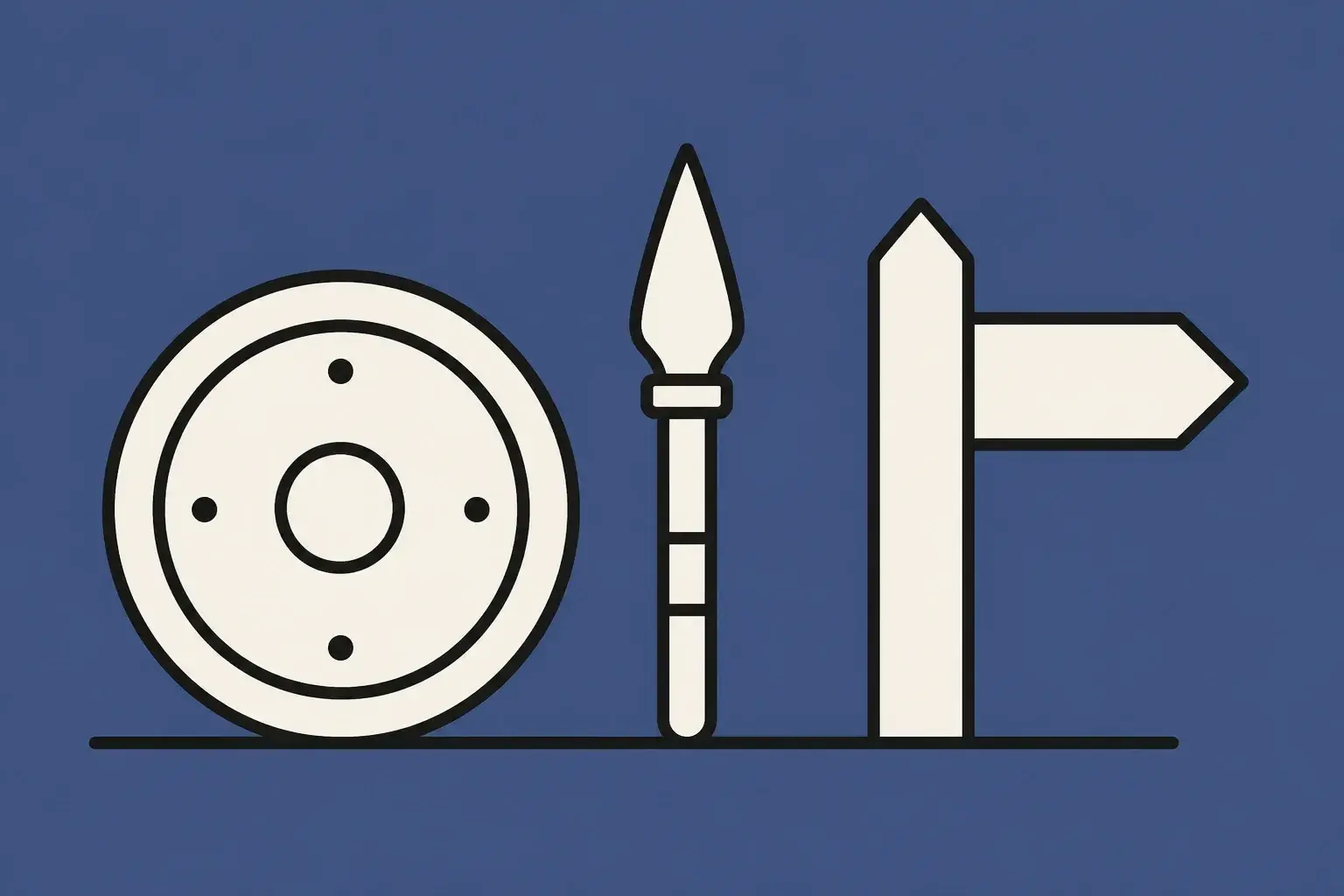
Three arcanas: pause, light, and direction
12: The Hanged Man
Arcana 12, the Hanged Man, points to a pause and a change of viewpoint. In shadow, a pause can feel humiliating, as if you have been held back, unheard, or made dependent on someone else’s decision. The impulse is to regain control through immediate action. In resource, 12 offers the rare ability not to reply from the first emotion. It is neither passivity nor consent to poor treatment. It is a short space in which facts, feelings, and another option besides attack or surrender can become visible.
19: The Sun
Arcana 19, the Sun, relates to openness, visibility, and the right to be seen. In shadow, it can be confused with the need to be the brightest, the most correct, and the strongest at all times. Someone else’s success then irritates, praise becomes a dose, and a mistake feels like public defeat. In resource, the Sun supports honest visibility: you can name your contribution, ask for recognition, celebrate a team result, and avoid diminishing another person. Presence does not need to be conquered when you neither hide yourself nor suppress those around you.
7: The Chariot
Arcana 7, the Chariot, gathers energy into a route. Its strength lies in a goal, preparation, pace, and the ability to lead. In shadow, a route is replaced by a rush: the main thing is to start, overtake, prove, and not look around. In resource, the Chariot asks questions that are especially useful for the Warrior: where exactly am I going, who is with me, what resources are needed, and where should I stop to check direction? Momentum becomes manageable. You do not lose speed; you stop spending it on unnecessary collisions.
A point of choice: competition or a shared result
Argues in order not to look weaker.
Names the disagreement and looks for a solution.
Demands an immediate reaction.
Agrees on a time and returns to the issue.
Hides exhaustion until a rupture.
Asks for resources or revises the workload.
Treats another person’s success as a threat.
Sees what can be learned and shared.
How to bring the Warrior into resource
Practice should not become one more demand: “Now I must always be calm.” Anger, impatience, and the wish to defend yourself have reasons. First, learn to notice the moment before acceleration: tension in the body, the urge to interrupt, the thought “they did this on purpose.” You can take a few minutes, postpone the conversation, or say, “I am irritated right now; I need to collect myself and return to the point.” This does not erase the issue. It keeps the issue from turning into a blow.
Then separate facts from interpretation. Fact: a colleague did not deliver their part by the deadline. Interpretation: they do not respect you and want to undermine you. Fact: a partner cancelled a meeting. Interpretation: the relationship does not matter to them. The interpretation may sometimes prove true, but it is worth checking with a question and an agreement first. That is not naivety. You can still require a deadline, an apology, or changed behaviour. Your action will simply rest on reality rather than immediate alarm.
If angry outbursts are frequent, if there is fear of harming yourself or someone else, a history of violence, or a sense that your reaction is completely out of your control, one article is not enough. Step away from the situation and seek urgent help or speak with a mental-health professional. A numerological image cannot replace safety, assessment, or support. It may remain a language for reflection, but protecting yourself and other people always matters more than finding an elegant explanation.
Five steps toward clear action
1
Name the goal in one sentence. Before a difficult conversation, write: “I need to agree on a deadline,” “I need the insulting language to stop,” or “I want to understand the decision.” If the sentence becomes “put them in their place” or “prove who is stronger,” pause and clarify what you are actually protecting.
2
Give your body time. Take several slow exhales, leave the chat for ten minutes, or put a glass of water beside you. A simple action will not solve the conflict, but it lowers the chance of writing or saying something you will later need to repair. If the conversation cannot wait, speak briefly and stay with facts.
3
Ask one question instead of delivering a counterblow. “How do you see the solution?”, “What prevented the agreement from being met?”, or “What do you need to fix this?” A question does not mean agreement. It gives information; without it, you may be arguing with your own assumption instead of the person in front of you.
4
State a boundary through your own action. For example: “I can discuss the budget until seven; after that I will return tomorrow,” or “If this becomes insulting, I will end the conversation.” A boundary is clearer than a threat because it does not try to control someone else. It explains what you will do.
5
Afterward, ask not only “Did I win?” but also “Did this become safer, clearer, and closer to the goal?” Note one moment that worked and one you would change. That turns an experience into a skill rather than another reason to accuse yourself of imperfection.
Frequently asked questions about 12-19-7
No. It is an image for observation, not a destiny script. Conflict can be necessary to protect a boundary or name a problem. The question is whether you can choose the form: conversation, refusal, agreement, support, distance—or only attack.
No. This combination does not ask you to become quiet or indifferent. Its mature side supports initiative, responsibility, and the ability to lead. It is useful only to check whether your action serves the task and the people involved, or merely proves you are stronger.
End contact, move to a safe place, and seek urgent help if there is a risk of harming yourself or someone else. If outbursts repeat, discuss them with a psychologist, psychotherapist, or doctor. An article cannot replace professional support.
Calculate your Matrix
See which energies and reflection prompts appear in your Matrix.
Calculate your Matrix